- September 16, 2026
- Posted by: admin
- Category: Uncategorized
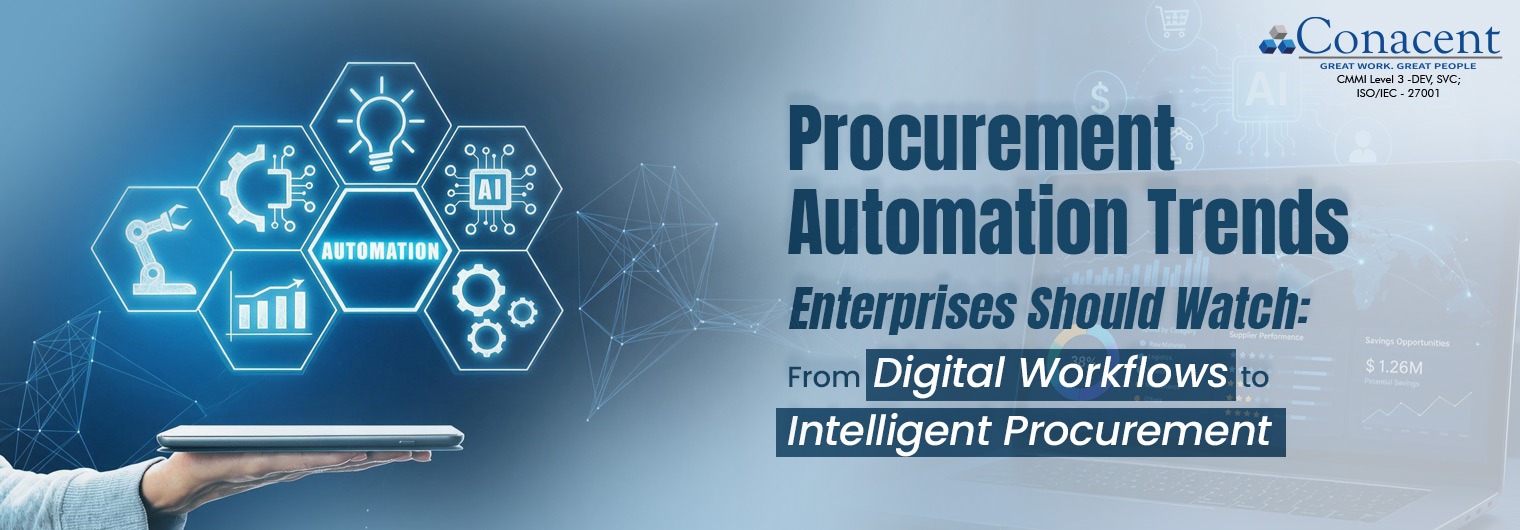
From digital workflows to intelligent, AI-driven procurement — what enterprise procurement teams need to know now.
It needs approval.
A supplier needs to be evaluated.
A purchase order needs to be created.
An invoice needs to be matched.
And somewhere in between, employees are still checking emails, updating spreadsheets, following up with suppliers, validating documents, and manually moving information between systems.
For many enterprises, procurement has already become digital.
But digital does not always mean automated.
Traditional procurement systems have helped organizations move away from paper-based processes and manual record keeping. Yet many organizations still depend on people to connect different stages of the procurement lifecycle.
As procurement becomes more complex, enterprises are now looking beyond basic process automation.
The next phase is about intelligent procurement, where automation, AI, analytics, enterprise systems, and human decision-making work together. This shift is changing what procurement teams can achieve.
Why Procurement Automation Is Becoming a Strategic Priority
Procurement is no longer limited to raising purchase orders and processing invoices. Enterprise procurement teams are expected to manage:
- Cost optimization
- Supplier performance
- Supply continuity
- Contract compliance
- Risk management
- Spend visibility
- Sustainability
- Internal stakeholder experience
- Regulatory requirements
At the same time, procurement teams are managing increasingly large volumes of data across suppliers, contracts, transactions, invoices, purchase orders, and external market information. Manual processes make it difficult to manage this complexity efficiently.
Automation can help organizations reduce repetitive work, improve visibility, standardize processes, and allow procurement professionals to focus on higher-value decisions.
The question for enterprises is therefore no longer simply: “How can we automate procurement?”
It is: “Which parts of procurement should become intelligent, automated, and increasingly autonomous?”
Procurement Automation Trends Enterprises Should Watch
1. Agentic AI Is Moving Procurement Beyond Traditional Automation
One of the biggest developments in procurement is the emergence of Agentic AI.
Traditional automation follows predefined rules. AI can analyze information and provide recommendations. Agentic AI takes the next step by enabling software agents to perform tasks and coordinate workflows based on objectives, rules, and available information.
In procurement, this could include activities such as:
- Supplier evaluation
- RFP creation and management
- Supplier risk monitoring
- Contract review
- Purchase order creation
- Renewal identification
- Procurement workflow escalation
- Negotiation preparation
The important shift is from “AI that assists procurement” to “AI that executes parts of procurement.”
2. Intelligent Source-to-Pay Automation
Procurement automation is increasingly moving beyond individual tasks. Instead of automating only purchase orders or invoice processing, enterprises are looking at the entire Source-to-Pay lifecycle.
This can connect: Requisition → Sourcing → Supplier Selection → Contract → Purchase Order → Goods Receipt → Invoice → Payment.
When these processes are integrated on a connected Oracle ERP backbone, information can flow across the procurement lifecycle without requiring employees to repeatedly transfer data between systems.
This creates opportunities for:
- Faster processing
- Better compliance
- Improved spend visibility
- Fewer manual interventions
- Stronger controls
- Better procurement analytics
The focus is shifting from isolated automation to connected, end-to-end procurement operations.
3. AI-Powered Spend Intelligence
Enterprises generate enormous amounts of procurement data. But collecting data is not the same as understanding it.
AI and advanced analytics are increasingly being used to identify:
- Spending patterns
- Maverick spending
- Supplier concentration
- Price variations
- Category opportunities
- Contract leakage
- Cost anomalies
- Potential savings
Instead of simply reporting what the organization spent, intelligent Enterprise Reporting & Dashboards can help identify why spending is happening and where action may be required — transforming procurement analytics from a reporting function into a decision-support capability.
4. Predictive Supplier Risk Management
Supplier risk has become a major enterprise concern. A supplier issue can affect production, inventory, customer commitments, and revenue.
Traditional supplier management often focuses on historical performance. Automation and AI enable enterprises to move toward more proactive risk management. Systems can combine supplier information with internal procurement data and external signals to identify potential risks earlier.
This can help procurement teams monitor:
- Supplier performance
- Delivery reliability
- Financial risk
- Supply disruptions
- Contract risks
- Compliance issues
- Dependency on critical suppliers
A connected Supplier Portal makes this monitoring easier by centralising vendor data and communication in one place. The objective is to identify potential problems before they become operational disruptions.
5. Intelligent Contract Management
Contracts contain critical commercial information: pricing, payment terms, renewal dates, volume commitments, service-level agreements, and compliance requirements.
Yet organizations often struggle to extract and monitor this information consistently. AI-powered contract technologies can help organizations review documents, identify important clauses, monitor obligations, and surface upcoming renewals.
This can reduce the dependency on manually reviewing large volumes of contracts. More importantly, it can help enterprises move from contract storage to contract intelligence.
6. Touchless Invoice Processing
Invoice processing is one of the most established areas for procurement automation. Yet many enterprises still have invoices arriving through multiple channels and requiring manual validation.
Automation can connect: Purchase Order → Goods Receipt → Invoice → Matching → Approval → Payment.
AI-powered document processing can also help extract information from invoices and identify exceptions, feeding directly into expense management and spend-control systems.
The objective is not necessarily to eliminate human involvement completely. Instead, automation can allow systems to process standard transactions while routing exceptions to employees for review — creating a more efficient exception-based procurement model.
7. Conversational Procurement and AI Assistants
Procurement interfaces are also changing. Instead of navigating multiple screens to find information, employees can increasingly interact with procurement systems using natural language. For example:
- “Show me our top suppliers for this category.”
- “Which contracts are expiring in the next 90 days?”
- “Create a purchase request for these approved items.”
- “Why has this supplier’s delivery performance declined?”
Conversational interfaces can make procurement systems easier for business users to access and understand. The next stage will be connecting these AI assistants directly with approved workflows so they can not only provide information but also help initiate and manage procurement actions.
8. Greater Integration between Procurement and Enterprise Systems
Procurement does not operate independently. It interacts with:
- ERP
- Finance
- Inventory
- Supply Chain
- Warehouse Management
- Supplier Platforms
- Contract Management
- HR
- Business Intelligence
As automation increases, integration becomes increasingly important. An intelligent procurement system needs access to reliable enterprise data.
For example, procurement automation becomes significantly more useful when it can understand: What is needed → Who needs it → What is already available → Which suppliers can provide it → What the contract allows → What has already been spent.
This is why procurement transformation increasingly depends on connected enterprise architecture — such as Oracle Fusion Cloud ERP or Oracle EBS — rather than standalone automation tools.
The Business Impact of Procurement Automation
When procurement automation is implemented effectively, enterprises can achieve improvements across multiple areas. These can include:
- Reduced manual processing
- Faster purchase cycles
- Improved spend visibility
- Better supplier management
- Reduced procurement errors
- Improved compliance
- Faster invoice processing
- Better contract control
- Improved decision-making
- Greater procurement productivity
But the real opportunity goes beyond efficiency. Automation can allow procurement professionals to spend less time processing transactions and more time managing suppliers, negotiating strategically, identifying savings, managing risk, and supporting business growth.
As procurement becomes more connected and intelligent, its role can shift from a transactional business function to a more strategic contributor to enterprise performance.
What Enterprises Should Consider Before Automating Procurement
Technology alone does not create successful procurement transformation. Enterprises should consider several foundational areas.
1. Data Quality
AI and automation depend on reliable data. Inconsistent supplier records, incomplete contracts, duplicate information, and poor categorization can limit the value of automation.
2. Process Standardization
Automating a poorly designed process does not necessarily improve it. Organizations should identify and simplify processes before automating them.
3. System Integration
Procurement automation needs to work with the enterprise technology ecosystem. ERP, finance, supplier, contract, inventory, and analytics systems should be able to exchange information effectively.
4. Governance and Controls
As AI becomes more involved in procurement decisions, enterprises need clear rules around permissions, approvals, data access, auditability, and human oversight.
5. Human + AI Collaboration
The future of procurement is unlikely to be about removing humans from every process. Instead, organizations will increasingly use AI for repetitive and data-intensive work while procurement professionals focus on judgment, relationships, negotiation, and strategic decisions.
How Conacent Helps Enterprises Transform Procurement
At Conacent, we believe procurement transformation is not simply about replacing manual processes with digital ones. The real opportunity is to create a connected procurement ecosystem where people, processes, technology, suppliers, and enterprise data work together.
With over 21 years of experience in enterprise transformation, Conacent helps organizations modernize procurement through technology, integration, workflow automation, and intelligent business solutions.
Our expertise includes:
- Enterprise Application Integration
- Digital Procurement Platforms
- Procurement Workflow Automation
- AI-Powered Invoice Processing
Supplier Collaboration Solutions
- Custom Business Applications
Enterprise Reporting & Dashboards
- Process Automation
- End-to-End Business System Integration
Our approach focuses on identifying high-value procurement processes, improving the underlying workflows, connecting enterprise systems, and introducing automation where it can create measurable business value.
For example, our Oracle EBS case study for an Engineering, Procurement & Construction enterprise shows how a connected ERP and procurement workflow reduced manual processing for a complex, multi-vendor operation.
The objective is not simply to automate procurement tasks. It is to build a procurement function that is faster, more intelligent, connected, and strategically valuable to the enterprise.
Looking Ahead
Procurement is entering a new phase.
The first wave of digital procurement focused on moving paper processes online. The next wave focused on workflow automation and process efficiency. The emerging phase is increasingly focused on AI-powered intelligence and autonomous execution.
Agentic AI, predictive analytics, intelligent document processing, connected Source-to-Pay platforms, supplier intelligence, and conversational procurement are changing what enterprise procurement can achieve.
But successful transformation will depend on more than adopting the latest technology. Enterprises will need strong data foundations, integrated systems, redesigned processes, governance, and people who know how to work effectively with intelligent technologies.
The organizations that get these foundations right will be better positioned to turn procurement from a transactional function into a strategic business capability.
The future of procurement will not be defined simply by how much work organizations automate. It will be defined by how intelligently they automate it.
The opportunity for enterprises is clear: build procurement systems that do more than process transactions. Build systems that understand, connect, predict, and act.
Frequently Asked Questions
### What is procurement automation?
Procurement automation uses software, workflow rules, and increasingly AI to handle repetitive procurement tasks — such as approvals, purchase order creation, supplier onboarding, and invoice matching — with minimal manual intervention.
### What is agentic AI in procurement?
Agentic AI refers to software agents that can take action on procurement tasks — such as evaluating suppliers, drafting RFPs, or flagging renewal deadlines — based on defined objectives and available data, rather than simply generating recommendations for a human to act on.
### How does Source-to-Pay (S2P) automation work?
Source-to-Pay automation connects every stage of the procurement lifecycle — requisition, sourcing, supplier selection, contracting, purchase order, goods receipt, invoice, and payment — into a single, integrated workflow so data does not need to be re-entered between systems.
### How can an enterprise get started with procurement automation?
Most enterprises start by auditing data quality and process consistency, then automate one high-volume, well-defined workflow — commonly invoice matching or purchase order approvals — before expanding into supplier risk monitoring and spend analytics. Conacent’s ERP & CRM consulting team can assess your current systems and recommend a phased automation roadmap.
### Expert Insight
“The future of procurement is not simply about automating transactions. It is about connecting data, intelligence, and execution so procurement can move from processing business activity to actively shaping business value.”
— Conacent Enterprise Transformation Practice
Ready to modernise your procurement function? Talk to a Conacent Consultant or explore our ERP & Procurement Services.
