- October 6, 2026
- Posted by: admin
- Category: Uncategorized
Procure-to-Pay Best Practices Every Enterprise Should Follow
Procure-to-Pay is more than a purchasing process.
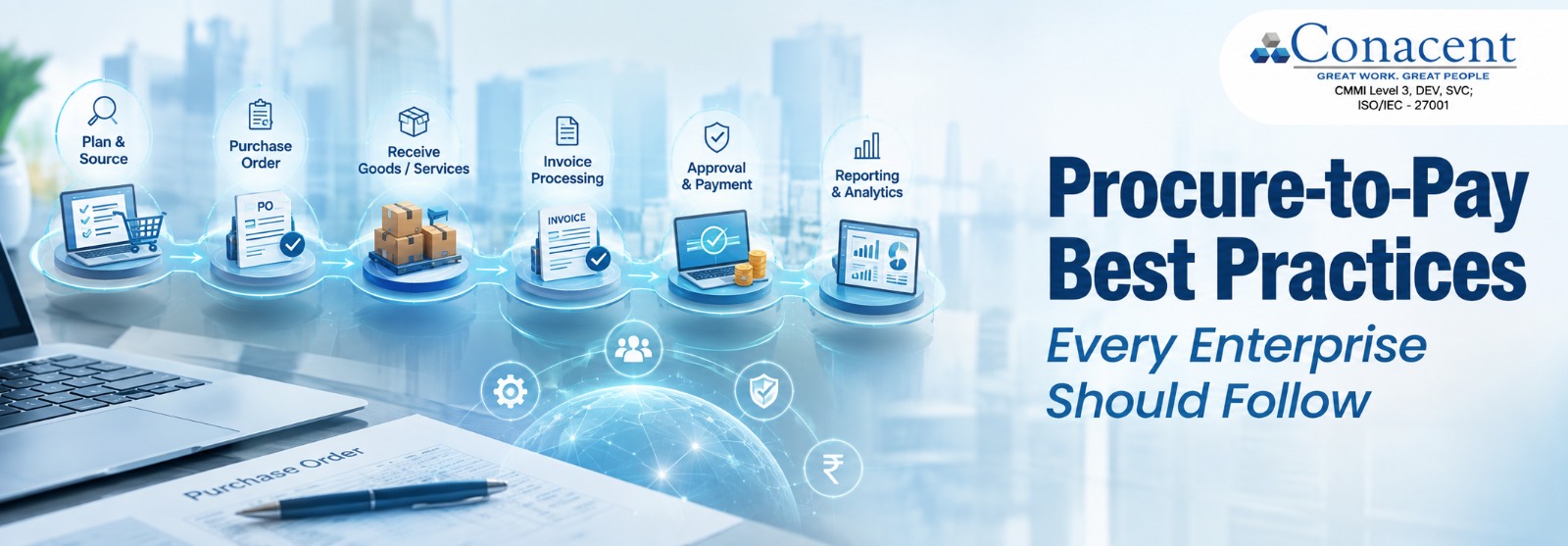
It connects how an enterprise identifies a requirement, selects suppliers, raises purchase orders, receives goods or services, processes invoices, makes payments, and ultimately analyses its spend.
When these activities operate through disconnected systems, manual approvals, spreadsheets, and fragmented supplier interactions, procurement can become slow, difficult to control, and challenging to measure.
A requisition may sit waiting for approval. A purchase order may not reach the supplier on time. An invoice may require repeated manual verification. Finance may lack visibility into outstanding payments, while procurement may struggle to understand overall spending patterns.
A well-designed P2P process brings these activities together into one connected workflow and one source of truth.
For enterprises, the objective is not simply to automate purchasing. It is to create a procurement environment that improves cost control, cycle times, compliance, supplier management, visibility, and decision-making.
This blog explores the key Procure-to-Pay best practices enterprises should follow to build a more connected and efficient procurement operation.
Why Procure-to-Pay Requires a Structured Approach
Enterprise procurement typically involves multiple departments, approval levels, suppliers, financial controls, and technology systems.
A complete P2P lifecycle may involve:
Each stage can affect the next.
For example, inaccurate purchase order information can create invoice exceptions. Delayed approvals can impact supplier timelines. Poor supplier data can make sourcing and reporting more difficult. Lack of visibility across transactions can also make it harder for management to identify leakage or control spend.
This is why P2P should be treated as an end-to-end business workflow, rather than a collection of individual procurement activities.
10 Procure-to-Pay Best Practices Every Enterprise Should Follow
1. Standardize the End-to-End P2P Process
One of the first steps toward improving P2P performance is establishing a standardized process from requisition to payment.
Enterprises should clearly define how a purchase moves through each stage:
Standardization helps reduce unnecessary variations between departments and business units.
For example, if different departments follow different approval procedures for similar purchases, procurement teams may have difficulty enforcing controls or measuring performance consistently.
A standardized workflow can establish:
The objective is to make the process predictable, measurable, and easier to automate.
Best-practice checklist:
2. Automate Purchase Requisitions and Approval Workflows
Manual requisition and approval processes can slow down procurement before a purchase order is even created.
Emails, spreadsheets, and informal approval mechanisms can make it difficult to determine where a request is currently sitting or who needs to take action.
Enterprises should introduce structured digital workflows for purchase requests.
A requester should be able to raise a requirement, provide relevant information, and automatically route the request to the appropriate approver based on predefined business rules.
For example, a low-value purchase may require departmental approval, while a high-value purchase may require additional financial or management authorization.
Automation can help:
This supports faster procurement without weakening financial controls.
3. Strengthen Sourcing and Supplier Selection
Procurement value is not created only when an order is placed. It begins much earlier during sourcing and supplier evaluation.
Enterprises should establish structured sourcing and bidding processes that allow procurement teams to compare suppliers based on relevant criteria.
Depending on the category, this may include:
Digital sourcing workflows can also make RFQ and tender processes easier to manage and track.
The objective should not simply be to select the lowest-cost supplier.
It should be to identify the supplier that provides the right balance of cost, quality, reliability, compliance, and business value.
4. Create a Centralized Supplier Management Framework
Supplier information is often distributed across procurement systems, finance records, spreadsheets, emails, and individual departments.
This creates challenges around data accuracy, supplier duplication, compliance, and performance tracking.
A structured supplier management framework should provide a consistent view of supplier information.
Enterprises should consider maintaining information such as:
Centralized supplier management can help procurement teams make more informed sourcing decisions while reducing administrative effort.
It also supports stronger supplier relationships because performance and interactions can be tracked more systematically.
5. Establish Strong Spend Controls
One of the key objectives of P2P is to control organizational spend.
Without appropriate controls, enterprises may experience:
P2P workflows should therefore connect purchasing activity with organizational policies and approval rules.
For example, an enterprise can establish predefined approval thresholds based on purchase value, category, department, or business unit.
This enables procurement teams to distinguish between routine purchases and transactions requiring additional review.
The goal is not to make procurement slower.
It is to control spend while keeping legitimate purchasing workflows efficient.
6. Improve Purchase-to-Payment Cycle Times
Cycle time is an important indicator of procurement efficiency.
Delays can occur at several stages:
An enterprise may automate one stage but still experience delays because another stage remains dependent on manual intervention.
For example, automating purchase order creation will not significantly improve the overall process if invoices continue to require manual verification and approval.
Enterprises should therefore measure cycle times across the complete P2P workflow. Useful measures include:
The objective should be to identify bottlenecks across the workflow rather than optimizing individual activities in isolation.
7. Strengthen Invoice Management and Three-Way Matching
Invoice processing is one of the areas where P2P automation can create significant operational value.
Enterprises need to verify that invoices correspond with actual purchases and receipts before payment is released.
A structured three-way matching process compares:
For example, if a purchase order is created for 100 units, only 90 units are received, and the supplier submits an invoice for 100 units, the system should identify the discrepancy rather than allowing the invoice to move through the process without review.
Automated matching can help identify:
This strengthens financial control while reducing the amount of manual verification required for standard transactions.
8. Build Strong Compliance and Audit Controls
Procurement processes must balance speed with governance.
Enterprises need appropriate controls around approvals, supplier selection, purchasing authority, invoices, payments, and documentation.
A well-designed P2P platform can create an audit trail across transactions, helping organizations understand:
Approval hierarchies, access controls, policy-based workflows, and documented exceptions can further strengthen governance.
The objective is to make compliance part of the workflow rather than an activity that happens only during an audit.
9. Use Analytics to Turn Procurement Data Into Decisions
A P2P system generates significant amounts of transaction data.
However, data alone does not create procurement value.
Enterprises need Spend analytics that can convert transactional information into actionable insights, supported by Enterprise Reporting and Dashboards. Spend analytics can help organizations understand:
For example, if an enterprise discovers that multiple departments are purchasing similar products from different suppliers at significantly different prices, procurement teams can investigate opportunities for supplier consolidation or better negotiation.
This moves procurement from transaction processing to informed decision-making.
10. Embed Automation and AI Across the Workflow
Automation should not be limited to purchase order creation.
Modern P2P environments can use automation and AI-enabled capabilities across multiple stages of the procurement journey. The P2P workflow can incorporate capabilities such as:
Intelligent Intake
Capture purchase requests in a structured manner and route them to the appropriate workflow faster.
Invoice Query Assistance
Help users retrieve information and resolve invoice-related exceptions more efficiently.
Spend Insights
Identify spending patterns and opportunities for improved control.
Workflow Automation
Automate approvals, notifications, routing, and exception handling.
The important principle is that automation should support the complete procurement workflow, rather than automate isolated tasks without connecting them to the larger process.
Common Procure-to-Pay Mistakes Enterprises Should Avoid
Even organizations with procurement systems in place can face inefficiencies when the overall P2P process is not properly designed.
Treating Procurement and Finance as Separate Processes
When procurement, invoice management, and payment activities operate independently, information gaps can develop between departments.
Excessive Manual Approvals
Approvals that depend heavily on emails and manual follow-ups can increase cycle times and reduce visibility.
Poor Supplier Data Management
Duplicate, outdated, or incomplete supplier information can affect sourcing, transactions, compliance, and reporting.
Weak Invoice Controls
Without structured matching and exception management, enterprises may face duplicate payments, invoice discrepancies, and unnecessary manual work.
Limited Spend Visibility
If procurement data is fragmented across systems, management may struggle to identify spending patterns and opportunities.
Automating Individual Tasks Instead of the Complete Workflow
Automating one part of P2P while leaving the remaining process disconnected can simply move the bottleneck to another stage.
Ignoring Exceptions
Standard transactions may flow efficiently while exceptions continue to require significant manual intervention. Enterprises should design workflows specifically for exception handling.
The key is to view P2P as a connected enterprise workflow, not simply a purchasing application.
How Conacent Helps Enterprises Transform Procure-to-Pay
At Conacent, we understand that procurement transformation involves more than automating purchase transactions.
With over
21 years of experience in enterprise transformation, the objective is to create a connected environment where sourcing, procurement, supplier management, invoice processing, payment management, and analytics work together.
Conacent’s P2P approach focuses on creating:
The P2P platform is designed around the principle of one connected workflow and one source of truth, helping enterprises gain greater visibility across the procurement lifecycle.
By connecting the stages from purchase requisition and sourcing through supplier selection, purchase order, goods receipt, invoice processing, three-way matching, payment, and spend analytics, enterprises can reduce process fragmentation and improve procurement control.
For example, our Oracle EBS case study for an Engineering, Procurement & Construction enterprise shows how a connected procurement workflow improved control for a complex, multi-vendor operation.
The objective is to help organizations move toward procurement operations that are more connected, measurable, automated, and insight-driven.
What Enterprises Should Measure in P2P
A successful P2P transformation should be measured through business and operational outcomes rather than simply system usage. Depending on the enterprise’s objectives, organizations can monitor:
Cost and Spend
Process Efficiency
Supplier Performance
Financial Control
Visibility and Decision-Making
Establishing baseline measurements before transformation makes it easier to determine whether the new P2P environment is delivering measurable improvement.
Looking Ahead
Procure-to-Pay is becoming increasingly important as enterprises look for ways to control costs, improve operational efficiency, strengthen supplier relationships, and make better use of procurement data.
The future of P2P is not simply about digitizing purchase orders or invoices.
It is about creating an intelligent, connected procurement ecosystem where workflows, suppliers, financial processes, analytics, automation, and AI-enabled capabilities work together.
When the complete lifecycle is connected, enterprises can move from fragmented procurement activities to a more unified operating model.
The real measure of P2P maturity is therefore not whether individual procurement tasks have been automated.
It is whether the enterprise can control spend, move faster, strengthen compliance, manage suppliers effectively, and turn procurement data into better decisions.
Because effective Procure-to-Pay is not just about processing purchases.
It is about creating a smarter way to manage the entire procurement journey. If you’re planning a broader ERP rollout alongside your P2P transformation, see our Oracle ERP Implementation Checklist for a step-by-step rollout plan.
Frequently Asked Questions
What is Procure-to-Pay (P2P)?
Procure-to-Pay is the end-to-end process an enterprise follows from identifying a purchasing need through supplier selection, purchase order creation, goods or service receipt, invoice processing, payment, and spend analysis — treated as one connected workflow rather than separate procurement and finance activities.
What is three-way matching in Procure-to-Pay?
Three-way matching compares the purchase order, the goods receipt, and the supplier invoice before payment is released, flagging discrepancies in quantity, price, or other details rather than letting mismatched invoices move through unreviewed.
What is maverick buying and how does P2P prevent it?
Maverick buying happens when employees purchase outside approved suppliers, contracts, or procurement policies. A well-designed P2P workflow connects purchasing activity to approval rules and spend controls, making non-compliant purchases easier to identify and reduce.
How is Procure-to-Pay different from Source-to-Pay?
Procure-to-Pay typically covers requisition through payment and spend analysis. Source-to-Pay (S2P) extends further upstream to include strategic sourcing, RFQ/tender management, and supplier selection before the procurement cycle begins — P2P is effectively the downstream half of the broader S2P lifecycle.
What causes the biggest delays in a P2P cycle?
Delays most often occur at approval stages and invoice verification, especially when these steps depend on manual emails or spreadsheets. Automating one stage in isolation — such as purchase order creation — rarely helps if invoice processing downstream still requires manual review.
How can an enterprise start improving its P2P process?
Most enterprises start by mapping their current end-to-end P2P workflow, measuring cycle times at each stage, and identifying where manual intervention creates the most delay — then prioritising automation there first. Conacent’s ERP & CRM consulting team can assess your current P2P workflow and recommend a phased transformation roadmap.
Expert Insight
“The value of Procure-to-Pay comes from connecting the entire journey. When sourcing, procurement, suppliers, invoices, payments, and analytics operate as one workflow, enterprises gain the visibility and control needed to make procurement more efficient and more strategic.”
— Conacent Enterprise Transformation Practice
Ready to connect your Procure-to-Pay workflow end to end?
Talk to a Conacent Consultant or explore our Oracle ERP & CRM services.
